Thessaloniki
Cartes Postales from GreeceThessaloniki is a city where public celebration, historical trauma, and ordinary street life meet. Ellie Thomas arrives seeking the warmth and noise of a crowd after days of solitude in Kalambaka; she stays far longer than planned. In its parade, university, museum, and old quarter, the city becomes both a place of encounter and a setting for her gradual return to the world.
Arrival and the Independence Day Parade
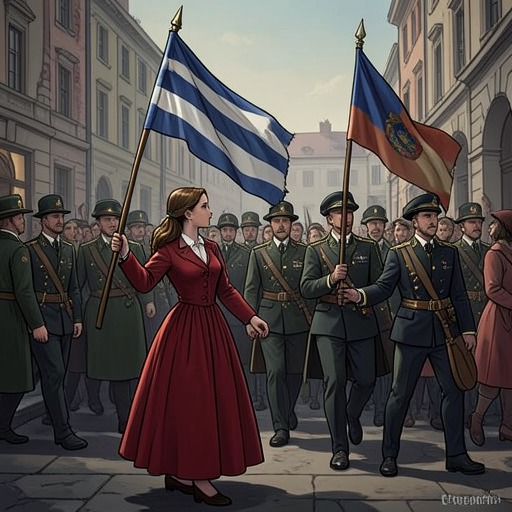
After a few days of walking in the quiet around Kalambaka, Ellie Thomas leaves for Thessaloniki, described as a three-hour journey on a good road. She is eager for crowds, loud music in a bar, and the smell of souvlaki in the street. On arriving, she checks into a hotel and walks down towards the sea and along the esplanade. The date is 25 March, and the spring day is warm; flags fill the balconies, public buildings, roads, and squares. Ellie is swept into a crowd gathered to watch thousands of schoolchildren, soldiers, and people in national costume march in the Independence Day parade.
The parade gives her a lesson in how history and emotion converge around the Greek flag. During a lull, an elderly man beside her describes the struggle for liberation from Ottoman rule as a holy war: in his telling, the Feast of the Annunciation and the departure of the Turks are bound together. He recalls that the Greeks were vastly outnumbered but insists that God was on their side. His wife and daughter have heard his stories before, but he welcomes Ellie as a fresh audience. As he raises his small flag, nearby people turn to listen, including a young woman holding her child. The scene shows national memory being retold not only in official ceremony but through an older man’s vivid account, delivered to strangers who stop and hear him.
The history behind the parade is presented on two different scales. The occupation by the Germans lasted three years, while Ottoman rule lasted nearly four centuries; every 25 March, the Greeks mark their liberation from the latter with a large parade. The date also commemorates the Annunciation, lending religious meaning to the national observance. The old man’s account makes that overlap personal: he speaks of the uprising as a cause sustained by faith, language, and tradition, and the flag in his hand becomes the visible focus of that remembrance.
A City Marked by Loss
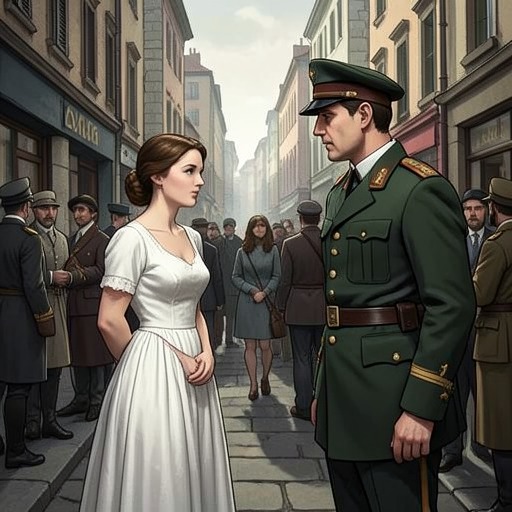
The celebratory streets do not erase Thessaloniki’s much darker history. The city is described as particularly scarred by the Holocaust: more than fifty thousand Jews, the majority of Greece’s Jewish population, were forcibly deported by train to Auschwitz, and very few escaped. Ellie reflects that the hardship the city endured is difficult to imagine on a sunny spring day, even as its memories remain present. The contrast between bright weather and the scale of past suffering gives the city’s lively surface a second register: public life continues, but the past has not disappeared.
The account also connects wartime destruction to the country’s later economic hardship. German troops, perhaps including Franz Dieter, are said to have destroyed resources as they retreated in 1944. Ellie encounters people who believe Germany still owes reparations for Nazi crimes, damage to infrastructure, and a forced loan taken from Greek banks; the alleged total is nearly 300 billion euros in present-day value. This figure is presented as a claim, not as a settled payment, and as an amount that could help address the debt burden crippling Greece. Thessaloniki therefore appears not merely as a monument to historical loss but as a place where memories of occupation remain entangled with arguments about present-day responsibility.
Museums, Work, and a Return to Public Life
Ellie stays in Thessaloniki for many more days than she intended. She finds it beautiful and fascinating, a city lively from dawn until dawn. Its large university lends it an atmosphere of youth and energy. A curator at the Archaeological Museum of Thessaloniki befriends her and invites her to lectures and events; Ellie is even asked to give a seminar. These encounters mark a concrete change in her circumstances: she is no longer only walking alone and turning over her past relationship in her mind. She is participating in conversations, attending events, and finding enough energy and inspiration to complete the first draft of her book.
That renewed engagement unfolds alongside the city’s historical layers. The museum offers Ellie a connection to the past through organized cultural life, while the streets bring her into contact with people whose memories and livelihoods are shaped by older traditions. Her stay thus moves between formal institutions and everyday encounters, from lectures and a seminar to music heard by chance in an alleyway. Thessaloniki’s role in her journey is not simply that of a destination; it provides the varied human company through which solitude gives way, gradually, to renewed involvement.
The Laterna in Ladadika
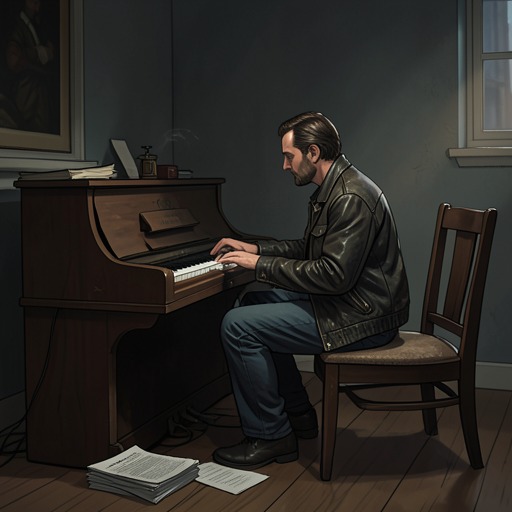
One afternoon Ellie wanders through the cobbled lanes of Ladadika, an area once full of olive-oil warehouses, and hears music that seems to carry her into a time she never experienced. Its sound lies somewhere between piano and stringed instrument, with an occasional bell-like chime. It recalls rebetiko, music that originated in Asia Minor, and stirs in her a nostalgia for an era and a home she has never known. Turning into a square, she finds the source: a decorated wooden barrel piano on wheels, played by turning a handle.
The player, Tassos, is around seventy and neatly dressed. After Ellie drops five euros into his upturned tambourine, he answers her questions. He explains that barrel pianos were once ubiquitous, glamorous, and popular before the gramophone, and that their production had largely ended after the 1950s. He opens the instrument to show how its wooden cylinder, pierced with hundreds of steel pegs, rotates as the handle turns. Each peg catches a spring-loaded hammer, which rises and falls onto a string to sound a note. The carefully made mechanism makes the past audible in the present, right in the middle of a city whose older ways are under pressure from change.
The instrument also carries a personal history. A black-and-white photograph framed with carnations is fixed to its side. Tassos tells Ellie that the barrel piano originally belonged to Panagiotis and that he now owns it. He remembers Panagiotis as the happiest man he knew. In 2010, when Greece’s finances were already in disorder and Tassos struggled to sell tissues and cigarette lighters because people had little cash, coins still flowed for Panagiotis: people were willing to give when they heard the laterna. The contrast makes the instrument a means of earning a living and a vessel for the past. Panagiotis regarded himself as an artist, not merely a street seller, and his music offered passers-by a glimpse of an earlier era. In Ladadika, Thessaloniki’s history is not confined to monuments or ceremonies; it turns in a wooden cylinder, gathers in a tambourine, and briefly draws strangers together around a song.